Indication training: why timing matters most
 Tobias Gustavsson

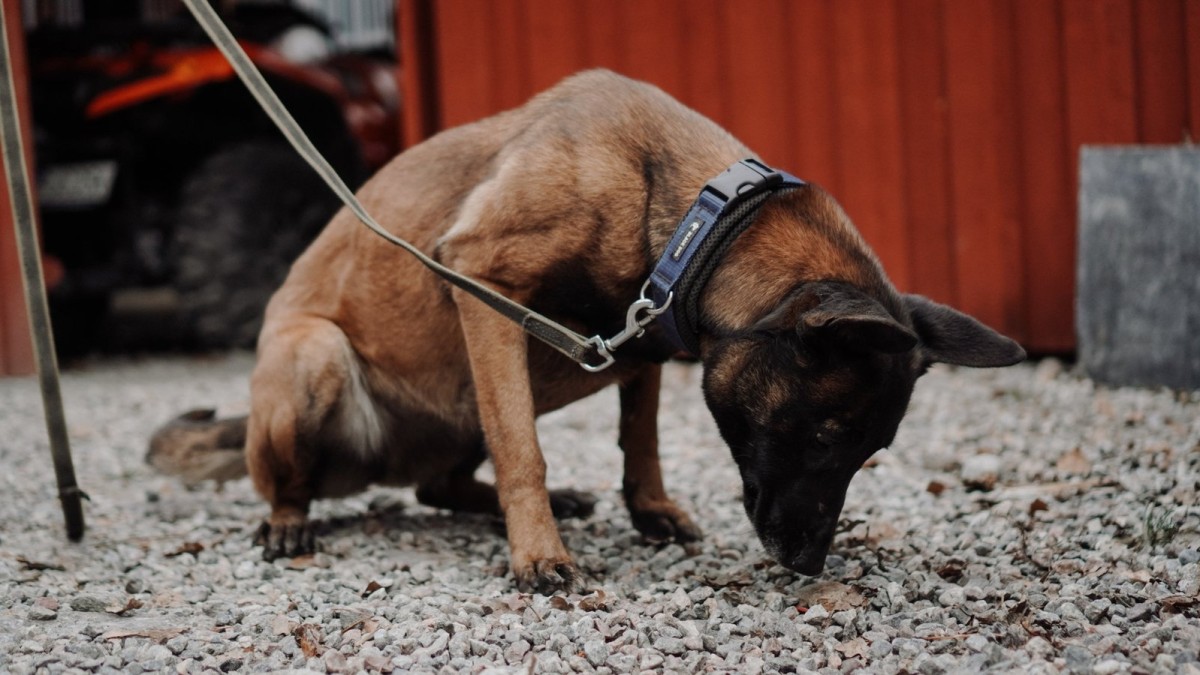
Indication training for scent work: why it is trained as a separate exercise, why timing matters, and the risk of starting it too early.
Indication training is the fourth phase of the foundations, and the one many handlers want to start with. It is also the easy part: once the foundations are in place, a fully trained indication doesn’t take long. Play and search development are what take the time.
This post is part of our foundation training series. For an overview of all the phases, start with Foundation training: where to start and what comes next.
What a good indication looks like
There are three types of passive indication: sit and stare, stand and stare (also called a freeze), and down and stare. Whichever you train, a good indication is precise and safe.
Take a sit and stare: your dog sits close to the hide without pushing it, the front legs stay locked where they were when your dog found the hide, and there is a straight line between the nose and the hide. A dog that backs away from the hide loses precision.
Which type suits your dog depends on the dog and on the job. A sit and stare can be a poor choice for a dog with too little prey drive: the sit gets too relaxed and the pointing less accurate, and a stand and stare may suit that dog better. Some dogs also tend to step back when they sit, which costs precision too. How much precision matters depends on what your dog is to detect. With small amounts of scent or buried hides it matters a lot, and the indication has to be built on the right kind of motivation.
Without enough reward and search development, any indication loses its precision: a sit and stare becomes a relaxed sit.
Trained on its own, built on drive
We train the indication as a separate behavior first, and connect it to the search later. The method depends on the type of indication. A sit and stare is built on the principle of active/passive: when the toy moves, your dog may chase it; when the toy is still, your dog stays passive. A stand and stare is quicker to train, straight on the wall, once search development is in place.
Either way, the indication rests on drive. A strong drive for the toy, from play development, is the reason your dog sits, focuses and waits for the toy to move again. Without it, indication training turns into an obedience exercise: the dog knows the skills but performs them with low intensity, and tends to indicate as soon as it feels unsure.
Why timing matters most
Indication training rewards passivity. Started too early, or connected to the search too early, it can cost your dog the intensity it built in search development. The indication becomes the default: instead of working hard to locate the hide, the dog indicates as quickly as possible, which is a very common cause of false indications. False indications have several causes; our webinar False indications: why do they happen? goes through them, and how to prevent and solve the problem. Also in Swedish: Blindmarkeringar och felmarkeringar.
If your dog needs more drive and intensity, the answer isn’t to wait for it to sit. Until your dog is ready, keep rewarding its reaction at the find, the short freeze in the second it finds the hide, and reward it fast. Adding the full indication later is easy, because by then your dog has both drive and focus on the hide.
A sit and stare has more training steps than the other indications, and it needs to be trained as a separate behavior. If you want a sit and stare, parts of the active/passive training can be done in parallel with search development, as long as your dog is highly motivated for the toy and used to leash tension. A stand and stare is a simpler process: you basically add duration before you reward your dog’s reaction at the hide.
Common mistake
Reward placement away from the hide. Your dog’s expectations should be at the hide, in front of it, not with you or somewhere else. Rewards that keep appearing behind the dog pull its focus away from the hide and make it sensitive to what happens behind it. Reward placement is covered in our Indication Training course.
Your part: handling
The indication is where handler influence shows most clearly. If you slow down or stop as your dog gets close to the hide, your dog soon learns that your stopping means “indicate here”: it looks back to check on you before it indicates. What to aim for is a dog that indicates because it has found the hide, not because you stopped. Keep your own behavior from becoming information, from early on in training.
One thing to keep in mind from the start:
Training tip
Build drive toward the hide before you add the sit. The more drive your dog has toward the target, the easier it is to adjust the distance and to stabilize a passive indication later on. Drive toward the hide also makes your dog less sensitive to what happens behind it.
For tracking dogs
Tracking starts only once your dog has a fully trained, solid and focused indication. The dog works at a distance from you, and without that indication, one of two things tends to happen: the dog is so keen to continue the track that it passes over the articles, or it stops and looks back at you before it indicates, and you become part of the cue.
A tracking dog is expected to indicate every kind of item in the track that holds scent from the person who laid it. In foundation training we use pieces of Kong; once the actual tracking training starts, the search and the indication move on to items of different sizes and materials.
The course for this phase
Our Indication Training course takes you through the method step by step:

Prefer a single recorded session? Our webinar Indication training for detection and tracking dogs covers the preparations before indication training, how the balance between searching and finding decides when to start, and the methods for detection and tracking dogs. The webinar gives you the theoretical overview; the course shows you every step of the practical training as well. Also in Swedish: Markeringsträning för sök- och spårhundar.
Ready for the next step: once your dog has a solid searching behavior and a solid indication, it’s time to start systematics. Play, search and indication training continue alongside, throughout your dog’s career.
Foundation training series · Part 4 of 6
For the inside view of our training, join our newsletter at the bottom of this page.
Categories: : Guides and tips
Keep training
Courses and webinars built on the same foundations.

Play Development Package
Webinar package
How to develop strong, reliable and conflict-free rewards.
View course
Search Development
Online course
How to train a highly focused and motivated detection dog.
View course
Indication Training — Sit and Stare
Online course
Everything you need to know about indication training for detection and tracking dogs.
View courseSign up and join the inner circle
You're not just on a list — you're in the room:
First access, before anyone else. Training days and live events fill up fast — often before we post about them. Subscribers hear first.
A real look inside the work. Once a month, we open up the operation: the travel, the placements, the training, the wins and the hard lessons.
Offers you won't see anywhere else. Subscriber-only pricing on courses, bundles, and gear — including drops we never announce publicly.
No spam. Unsubscribe anytime.