Play and reward development: the reward everything depends on
 Tobias Gustavsson

Play and reward development: why the reward comes first, how chasing games and social play build it, and what to watch with a puppy.
Every dog we train starts here. Play and reward development is the first phase of the foundations: building a reward your dog wants badly, works for reliably, and enjoys without conflict. Everything later in training depends on it.
This post is part of our foundation training series. For an overview of all the phases, start with Foundation training: where to start and what comes next.
Why the reward comes first
The reward is what your dog works for. In search development, it's what makes searching and finding worth the effort; in indication training, it's what the indication earns. If the reward is weak, unreliable or comes with conflict, every later phase inherits the problem.
A good reward is strong, reliable and conflict-free. Strong means your dog goes for the toy with acceleration, intensity and a determined attitude. Reliable means it works the same way wherever you train. Conflict-free means your dog wants to play with you and isn't stressed or frustrated by the game: a dog can play at low intensity and still get stressed, just by the way we play.
Focus, intensity and acceleration are hard to measure, but they are criteria all the same. Playing a lot with your dog is how you develop an eye for them.
It starts with food
In reward development, we aim for a wide range of rewards: from low to high intensity, from short and quick to longer reward events. We start with food. We rarely use food rewards in detection and tracking themselves, but they are valuable in many other parts of training. They keep the reward frequency high without ending the behavior each time, and they keep stress low while the dog learns something new.
This goes for high-drive dogs too. Food games give you access to calmer forms of reward, and some dogs are so wound up that they can’t eat at all; they need to learn to.
Food games add movement and speed: the dog chases the food in your hand. That stimulates the prey drive, prepares the movements your dog will use when the toy comes in, and teaches it to focus on what is in front of it, a principle many detection exercises build on later. What to aim for is engagement through the whole reward: the better your dog performs, the more it gets paid.
Food games are also good physical preparation for the more intense chasing games. They prepare your dog’s body for the movements it will make at higher speed later on, and give you a chance to spot any physical limitations or lack of body awareness.
Chasing games and social play
Play development has two parts, trained in this order, and then side by side.
Chasing games
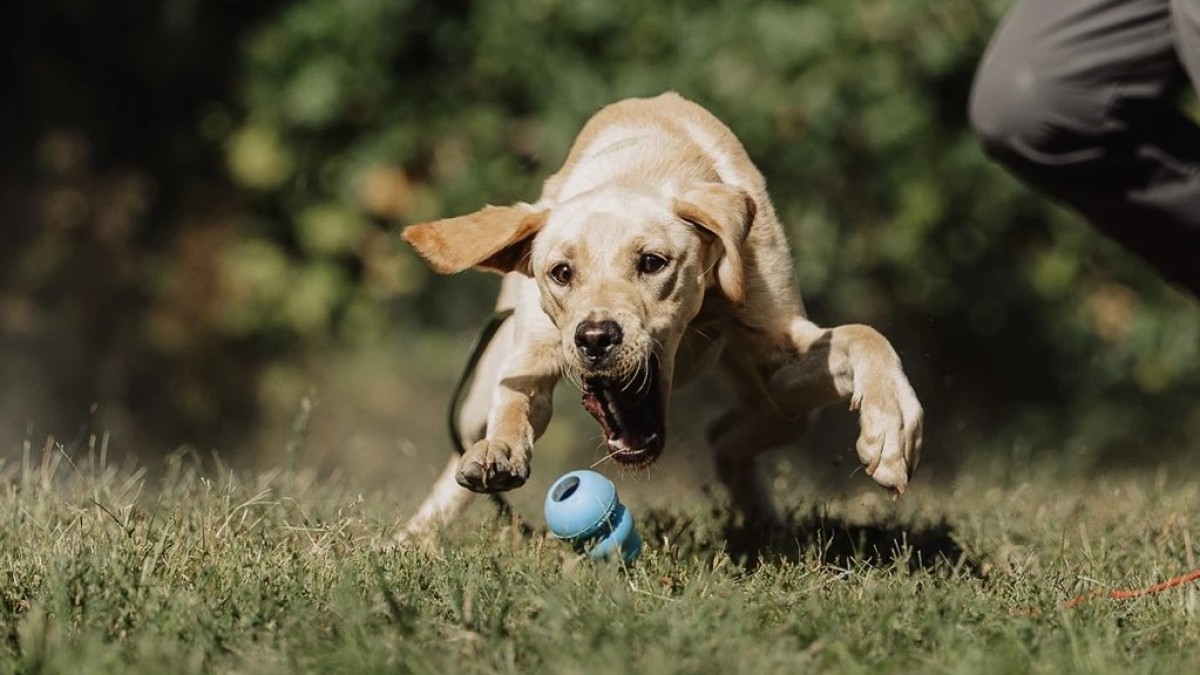
Chasing games build drive, engagement and focus. The aim is to increase your dog's drive and intensity without causing stress.
Their purpose is motivation for the toy itself, through a kind of play that isn't directly social, as tug games usually are. That is why chasing games suit the rewards in search and tracking, where the handler's influence has to be kept out. Choose a toy you can hold in one hand: a toy held with both hands quickly turns the play social, with you facing the dog and higher up.
What to aim for: strength, acceleration, intensity and attitude when your dog goes for the toy, and a clear idea of where on the toy to bite. Clear targeting makes the grip more decisive and the play safer.
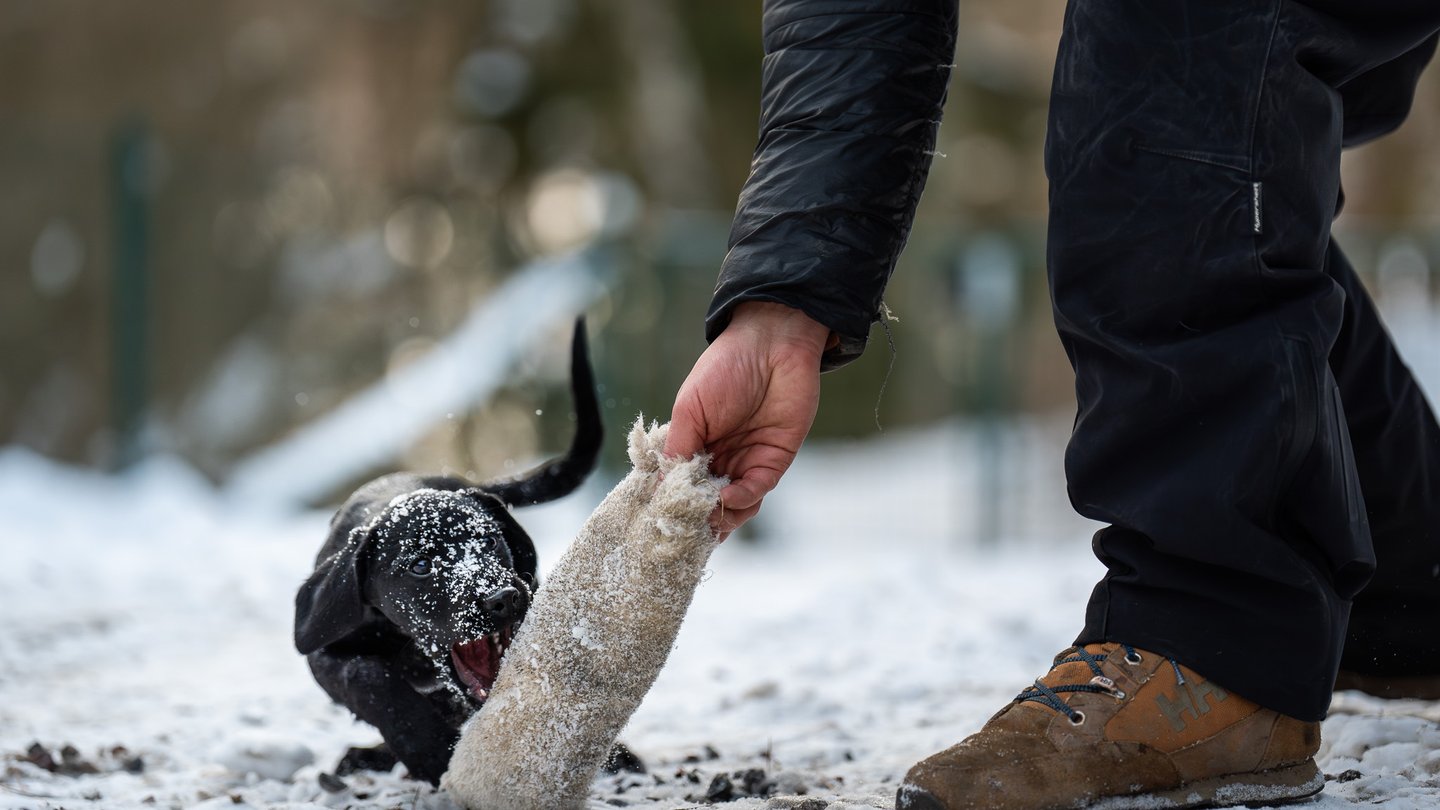
Chasing games also shape the focus you want at the start of a search later on. A dog that learns to wait for movement in front of it closes its mouth and concentrates. That detail is the difference between a dog that gets stressed by intense play and a dog that turns the intensity into focus.
What about the “out”? Whatever your dog, build high drive and motivation first, and wait with the “out”. Then it depends on the dog. If your dog never gives you a chance to take the toy, a reliable, conflict-free “out” is a must before you move on to the next phase; otherwise training gets frustrating and slow. As with indication, the “out” is easier to train once motivation for the toy is high. There are a number of different techniques for training a reliable “out”, and they are covered in detail in our play development webinars.
Social play
Social play uses the drive from the chasing games and adds social interaction: control and cooperation in play. This is where your dog learns to come back to you with the toy.
In early scent work training, keep it in proportion. What matters most is the chase and the focus on the toy, not a dog with high expectations of you as a handler. Social play is useful in any training where you want your dog to be more focused on you, and later on, it becomes a very useful reward in scent work too.
What to aim for: a dog that is comfortable playing close to you, cooperates with you even when there is only one toy, and comes back to you with the toy, quickly, to play again. Positive expectations close to you are what bring your dog back. If the return doesn't work, it causes problems in all later training where the reward is a toy.
Common mistake
In the early stages of play development, a common mistake is not letting your dog win the toy quickly enough, or introducing too much social play, such as tug games.
Both move the motivation away from the toy itself: a dog that rarely wins gets frustrated or loses motivation, and a dog that mostly plays tug with you learns that the reward is the game with you. Getting the balance right is covered in the Play Development Package.
Chasing games and social play are both covered in our webinar package:

Is your dog hard to motivate? Our webinar Reward development for dogs that are difficult to motivate shares the principles and techniques that helped us with the dogs we struggled with most. Also in Swedish: Belöningsutveckling för svårmotiverade hundar.
Your part: handling
Play and reward development trains you as much as your dog. Leash work, coordination and timing decide whether the toy moves in a way your dog expects and is motivated by, whether the reward comes at the right moment, and whether the leash helps or gets in the way. Food games are a good place to practice the movements you will later use with the toy, and simple equipment helps: when nothing gets in the way, you can predict the effect of your own movements.
One thing to practice from the start:
Training tip
Play with the leash and collar on. A dog that is used to the leash, and to leash tension during play, is well prepared for the later phases, where leash tension is used to build drive toward the hide and in indication training.
Training a puppy
The methods are the same for a puppy and an older dog. With a puppy, the choice of toys and the way you play need some extra thought, both before and during teething.
Until the milk teeth have changed (around seven months), use toys in soft material, such as a cloth: comfortable to bite and kind to the teeth. Once the adult teeth are in, move on to the Kong, starting with a small one that is easy to pick up and hold, and keep at it until your dog bites it with the same force and desire as the cloth.
Puppy time is for reward development, search development and socialization: new places, new people. It is not the time for indication training. Indication is the easy part and comes later; play and search development are what take months.
Our puppy training webinar goes into this in more detail:
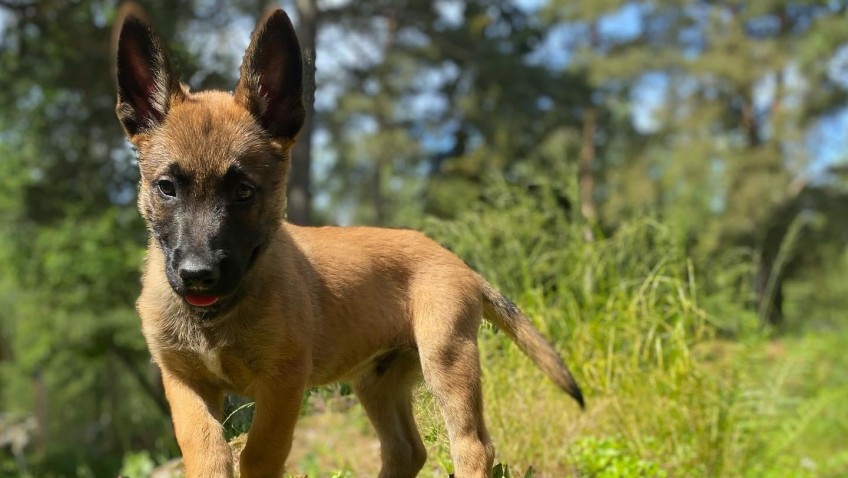
Ready for the next step: start search development once your dog shows high motivation for chasing and biting the toy. Play and reward training doesn't stop there: it continues alongside search development, and throughout your dog's career.
Foundation training series · Part 2 of 6
For the inside view of our training, join our newsletter at the bottom of this page.
Categories: : Guides and tips
Keep training
Courses and webinars built on the same foundations.
Play Development Package
Webinar package
How to develop strong, reliable and conflict-free rewards.
View course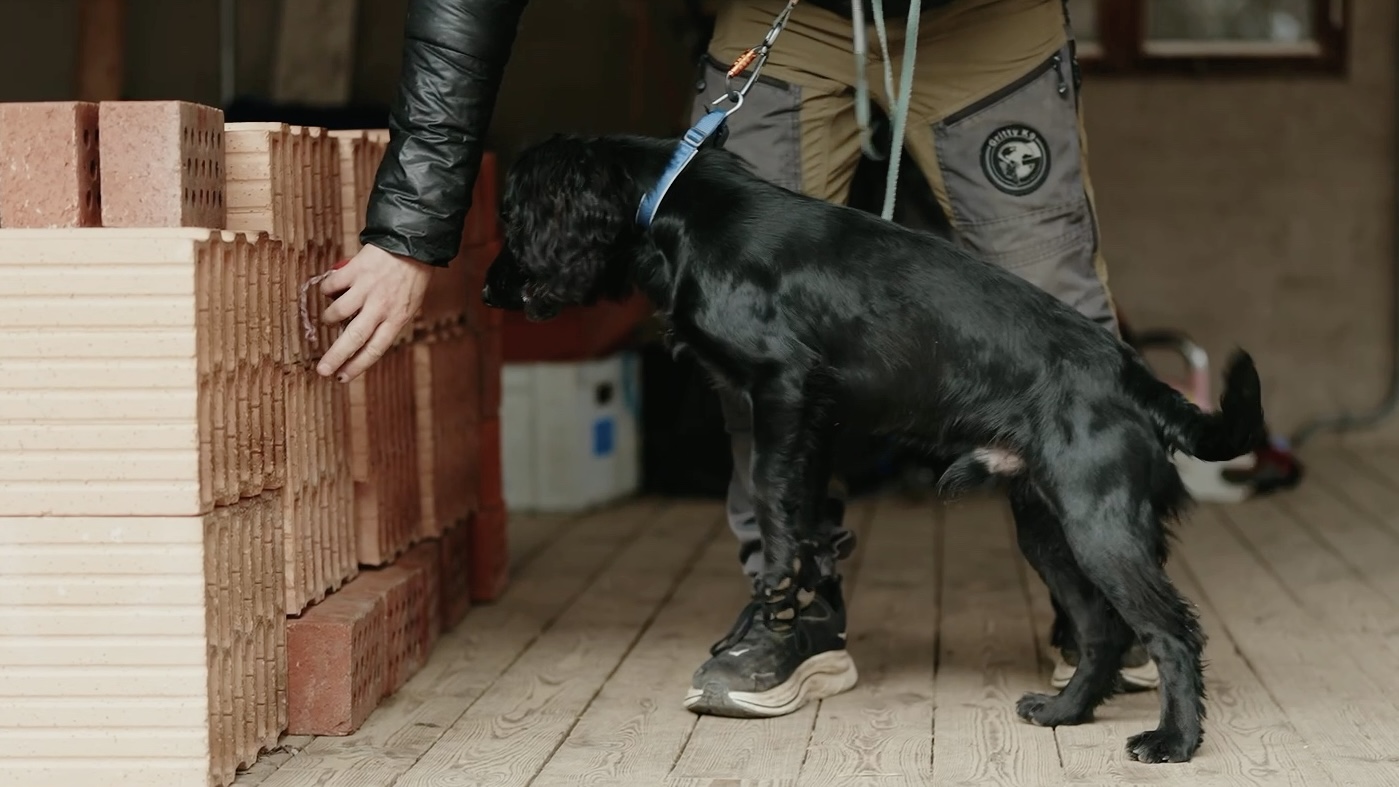
Search Development
Online course
How to train a highly focused and motivated detection dog.
View course
Indication Training — Sit and Stare
Online course
Everything you need to know about indication training for detection and tracking dogs.
View courseSign up and join the inner circle
You're not just on a list — you're in the room:
First access, before anyone else. Training days and live events fill up fast — often before we post about them. Subscribers hear first.
A real look inside the work. Once a month, we open up the operation: the travel, the placements, the training, the wins and the hard lessons.
Offers you won't see anywhere else. Subscriber-only pricing on courses, bundles, and gear — including drops we never announce publicly.
No spam. Unsubscribe anytime.